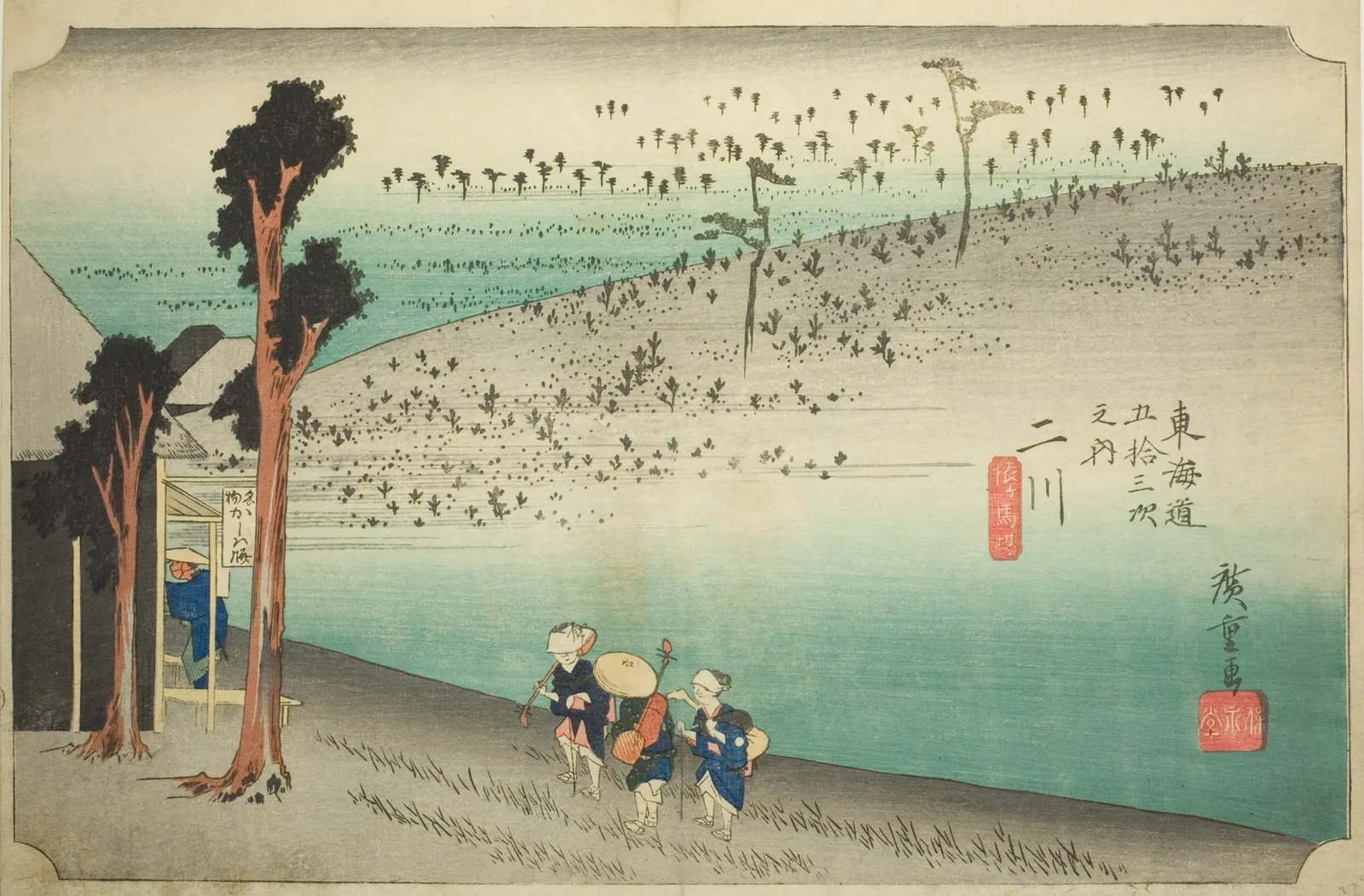
The Fifty-three Stations of the Tokaido (Hoeido edition) ・ 34
Sarugababa Rest Stop at Futakawa
東海道五拾三次之内 二川 猿ヶ馬場
Three goze carrying musical instruments walk at the foot of a hill dotted with small pines. At a roadside teahouse hangs a sign for the specialty kashiwa mochi, and the print depicts a quiet moment on a highway with few travelers.
- Artist
- Utagawa Hiroshige
- Date
- c. 1833-34 (Tenpo 4-5)
- Medium / format
- Woodblock print (ukiyo-e)
- Series
- The Fifty-three Stations of the Tokaido (Hoeido edition) 55 prints
- Place depicted
- Futagawa-juku(Aichi)
About this work
Most of the picture is occupied by a gently spreading hill. Countless small pines, called hime-komatsu, are drawn on it and continue to the back along the undulations of the hill. The line of the hill runs diagonally from the upper left to the right, and a pale green gradation softens the boundary between hill and sky. Near the top of the hill, two especially tall pines stretch slender.
Walking the road in the foreground are three goze, blind women itinerant entertainers. Goze traveled around the country, making a living by playing the shamisen and other instruments and singing for listeners. According to the Tokyo Fuji Art Museum, each of the three carries an instrument. The indigo of their kimono and the ocher of their large hats stand out against the gray road.
On the sign at the teahouse at the far left is written Famous Kashiwa Mochi, showing that kashiwa mochi was the local specialty here. Inside the shop a customer rests alone. Sarugababa, named in the title, was a place known for its view of hime-komatsu. Without placing a grand highlight, the print expresses the loneliness of the highway through a wide hill and small human figures. The teahouse pushed to the left edge and the two tall trees give weight to the broad, open picture.
The place today
In Futagawa-juku remain buildings of the Baba family, who served as honjin, open to the public as the Futagawa-juku Honjin Museum. Next to it are the hatago Seimeiya, built in 1817 (Bunka 14), and nearby the merchant house Komaya, so that a honjin, hatago, and merchant house can all be toured together.
Where can I see it?
Exhibitions change over time. Check each museum's exhibition information before you visit.
Museums that hold this work
- Tokyo National MuseumMuseum's page for this work (opens in a new tab)
Taito City, Tokyo Accession no. A-12499-38
Museums that hold this series (please check the museum's website for whether it holds this print)
- Shizuoka City Tokaido Hiroshige Museum of Art
Shimizu Ward, Shizuoka
All prints of the Hoeido edition were shown in the museum's collection exhibition Fifty-three Stations of the Tokaido (2024-25)
Museums abroad
- Art Institute of ChicagoMuseum's page for this work (opens in a new tab)
Chicago Accession no. 1925.3538
Frequently asked questions
- Who painted The Fifty-three Stations of the Tokaido: Sarugababa Rest Stop at Futakawa, and when?
- The Fifty-three Stations of the Tokaido: Sarugababa Rest Stop at Futakawa is by Utagawa Hiroshige, made in c. 1833-34 (Tenpo 4-5). Medium: Woodblock print (ukiyo-e).
- What place does The Fifty-three Stations of the Tokaido: Sarugababa Rest Stop at Futakawa show?
- It shows Futagawa-juku (Aichi).
- Where can I see The Fifty-three Stations of the Tokaido: Sarugababa Rest Stop at Futakawa?
- It is held by Tokyo National Museum, Tokyo Fuji Art Museum, National Diet Library. Exhibitions change, so check each museum's information before you visit.
Sources and references
- Art Institute of Chicago: Futakawa: Sarugababa Plateau (Futakawa, Sarugababa) (opens in a new tab) (checked 2026-10-18)
- ColBase(東京国立博物館): A-12499-38 (opens in a new tab) (checked 2026-10-18)
- 東京富士美術館 収蔵品: 東海道五拾三次之内 二川 猿ヶ馬場 (opens in a new tab) (checked 2026-10-18)
- 国立国会図書館デジタルコレクション: 東海道五拾三次 二川・猿ケ馬場 (opens in a new tab) (checked 2026-10-18)
You may also like
More from Aichi
Discover more of the same region on our sister sites.
Matsuri Biyori
Festivals in Aichi
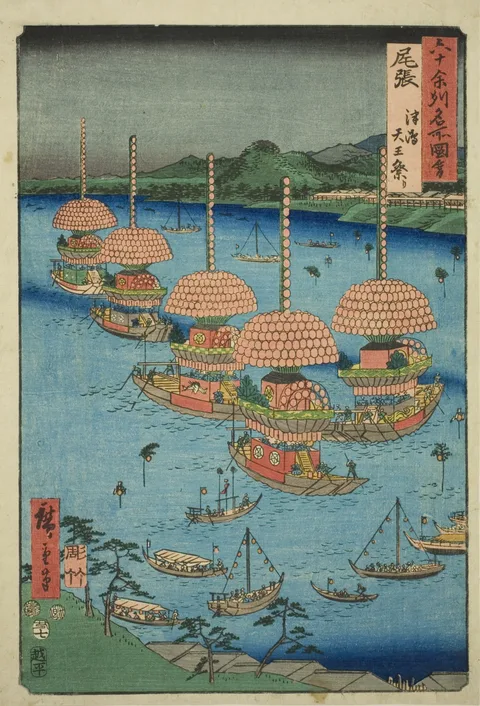
- Owari Tsushima Tenno Festival Danjiri-bune Boat Event
- Chiryu Dashi Bunraku and Karakuri
- Inuyama Festival Yama Float Event
- Kamezaki Shiohi Festival Float Event