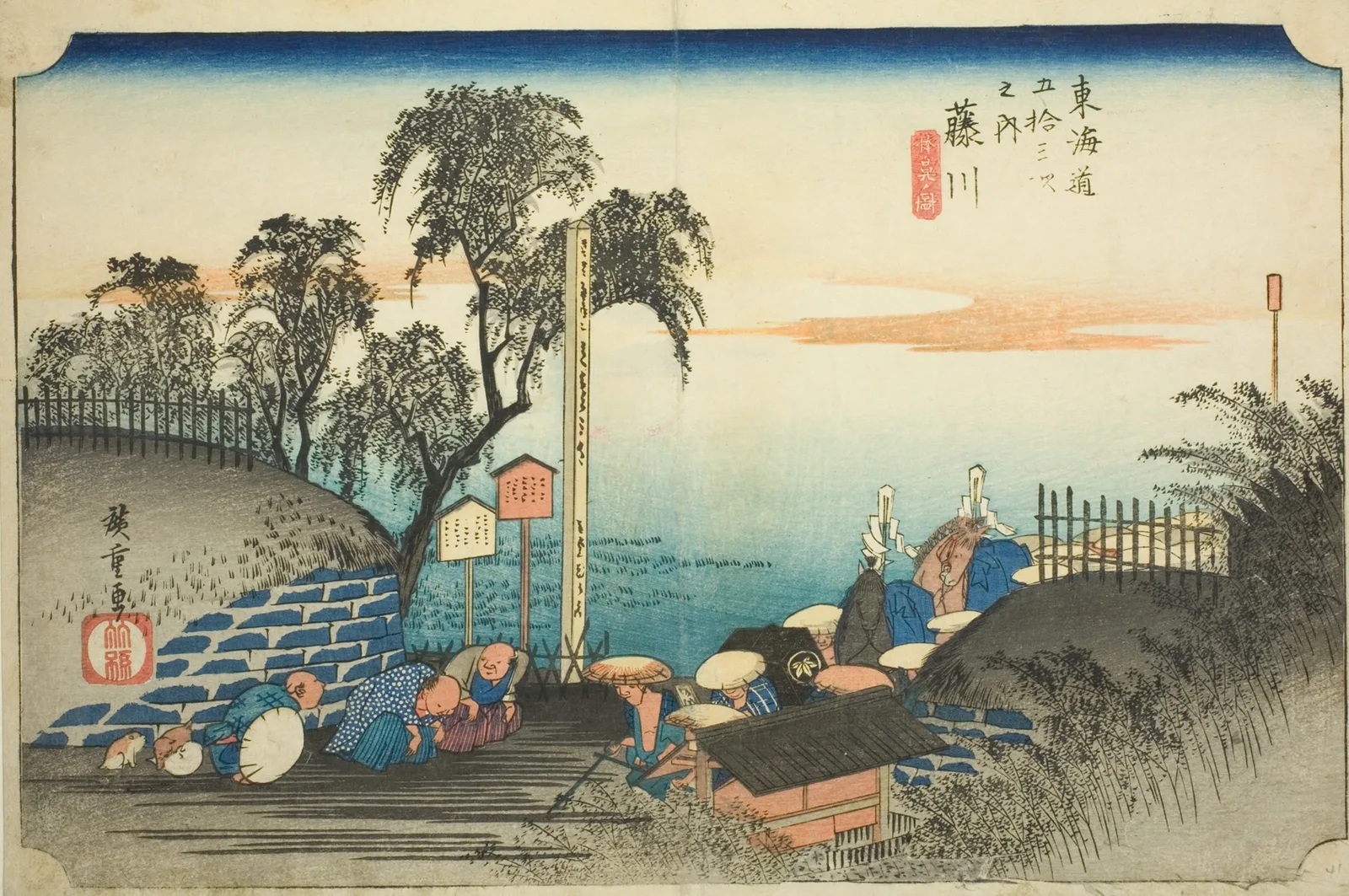
The Fifty-three Stations of the Tokaido (Hoeido edition) ・ 38
Boundary Marker near Fujikawa
東海道五拾三次之内 藤川 棒鼻ノ図
At the bohana, the entrance of Fujikawa-juku, post-station officials bow with hands on the ground to welcome a procession. The horse bearing a gohei is a horse being presented to the imperial court, which the Tokyo Fuji Art Museum explains as a party presenting horses for Hassaku.
- Artist
- Utagawa Hiroshige
- Date
- c. 1833-34 (Tenpo 4-5)
- Medium / format
- Woodblock print (ukiyo-e)
- Series
- The Fifty-three Stations of the Tokaido (Hoeido edition) 55 prints
- Place depicted
- Fujikawa-juku(Aichi)
About this work
At the center of the picture stands a tall boji-gui stake marking the boundary of the post station, with a notice board posted beside it. This place at the entrance of the station is the bohana. In the left foreground, people who appear to be post-station officials bow with their hands on the ground to welcome the procession. Behind the stake, a large leafy tree spreads its branches.
In the procession advancing from the right is a horse bearing a white gohei (a paper ornament used in Shinto rites). The Tokyo Fuji Art Museum identifies this as the procession of the Hassaku Onma Shinken, in which the shogunate presented horses to the imperial court on Hassaku (the first day of the eighth lunar month). There is a theory that Hiroshige joined this party on his journey along the Tokaido, which led to the making of the series. In the procession, attendants in hats advance overlapping one another.
At the officials' feet, two small dogs look toward the procession. Adding small dogs to a solemn ceremonial setting gives the picture some softness. Beyond the road between a stone wall and an embankment spread rice paddies, and faint red clouds float in the sky. The print cuts out a moment of ceremony at the boundary every traveler into and out of the post station had to pass.
The place today
On the site of Fujikawa-juku's waki-honjin stands the Fujikawa-juku Museum, where a gate rebuilt after the great fire of 1719 (Kyoho 4) survives. The nearby honjin site has been developed as a plaza, and the notice-board site has been restored. The station has sites of the east and west bohana, and at its edge continues the Fujikawa pine avenue, with black pines lining about 1 km.
Where can I see it?
Exhibitions change over time. Check each museum's exhibition information before you visit.
Museums that hold this work
- Tokyo National MuseumMuseum's page for this work (opens in a new tab)
Taito City, Tokyo Accession no. A-12499-42
Museums that hold this series (please check the museum's website for whether it holds this print)
- Shizuoka City Tokaido Hiroshige Museum of Art
Shimizu Ward, Shizuoka
All prints of the Hoeido edition were shown in the museum's collection exhibition Fifty-three Stations of the Tokaido (2024-25)
Museums abroad
- Art Institute of ChicagoMuseum's page for this work (opens in a new tab)
Chicago Accession no. 1925.3542
Frequently asked questions
- Who painted The Fifty-three Stations of the Tokaido: Boundary Marker near Fujikawa, and when?
- The Fifty-three Stations of the Tokaido: Boundary Marker near Fujikawa is by Utagawa Hiroshige, made in c. 1833-34 (Tenpo 4-5). Medium: Woodblock print (ukiyo-e).
- What place does The Fifty-three Stations of the Tokaido: Boundary Marker near Fujikawa show?
- It shows Fujikawa-juku (Aichi).
- Where can I see The Fifty-three Stations of the Tokaido: Boundary Marker near Fujikawa?
- It is held by Tokyo National Museum, Tokyo Fuji Art Museum, National Diet Library. Exhibitions change, so check each museum's information before you visit.
Sources and references
- Art Institute of Chicago: Fujikawa: View of Post Outskirts (Fujikawa, bohana no zu) (opens in a new tab) (checked 2026-10-18)
- ColBase(東京国立博物館): A-12499-42 (opens in a new tab) (checked 2026-10-18)
- 東京富士美術館 収蔵品: 東海道五拾三次之内 藤川 棒鼻ノ図 (opens in a new tab) (checked 2026-10-18)
- 国立国会図書館デジタルコレクション: 東海道五拾三次 藤川・棒鼻ノ図 (opens in a new tab) (checked 2026-10-18)
You may also like
More from Aichi
Discover more of the same region on our sister sites.
Matsuri Biyori
Festivals in Aichi
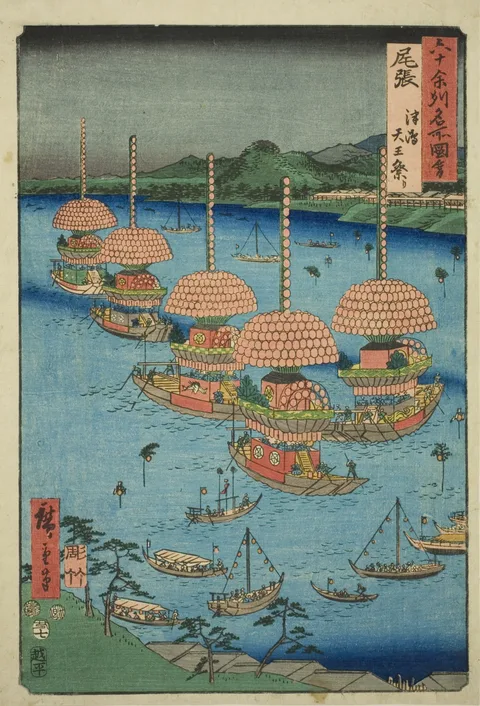
- Owari Tsushima Tenno Festival Danjiri-bune Boat Event
- Chiryu Dashi Bunraku and Karakuri
- Inuyama Festival Yama Float Event
- Kamezaki Shiohi Festival Float Event