Flowering Plants of Summer and Autumn
夏秋草図屏風
Sakai Hoitsu · 19th century (Edo period) · Folding screen
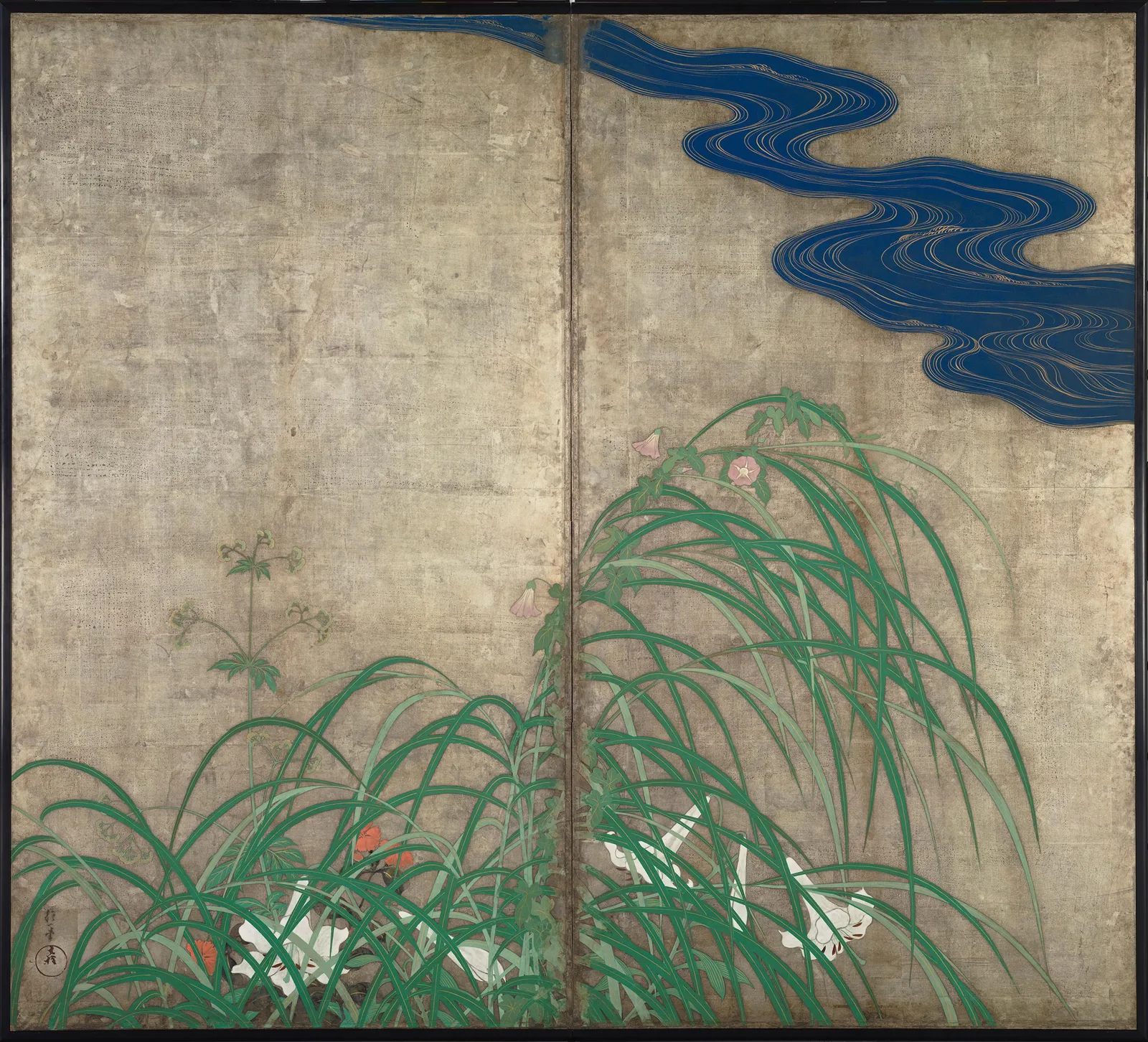
One screen of a pair. Image: Source: ColBase (Work page (opens in a new tab)) (reduced in size on this site) Public Data License 2.0 of the Government of Japan (compatible with CC BY 4.0) (opens in a new tab) View larger
The Important Cultural Property "Flowering Plants of Summer and Autumn" by Sakai Hoitsu is a pair of 19th-century (Edo period) screens showing summer and autumn plants on a silver ground, painted on the back of Ogata Korin's "Wind God and Thunder God" screens. It is held by the Tokyo National Museum.
- Artist
- Sakai Hoitsu
- Date
- 19th century (Edo period)
- Medium / format
- Folding screen
About this work
Sakai Hoitsu added this work later on the back of Ogata Korin's "Wind God and Thunder God" screens. It was commissioned by Hitotsubashi Harusada, the head of the Hitotsubashi family and father of the eleventh shogun, Tokugawa Ienari. For conservation, the front and back were separated in 1974, and they are now separate screens. It is color on paper with a silver ground, and each screen measures 167.0 cm high by 184.0 cm wide. It is designated an Important Cultural Property.
On a silver ground reminiscent of moonlight, summer and autumn plants are rendered in fresh colors. On the right screen, summer plants such as lilies and bindweed droop with their leaf tips toward the ground, and rainwater collected on the ground flows away in the background, expressing a heavy evening shower without painting raindrops. On the left screen, autumn plants such as kudzu, thoroughwort, pampas grass, and wild grape bend widely in the wind, and the wild grape swirling in the air and the color of the overturned leaves convey the strength of the wind.
The summer plants were originally on the back of the Thunder God screen and the autumn plants on the back of the Wind God screen, so the summer plants are beaten by the rain brought by the Thunder God and the autumn plants blown by the wind raised by the Wind God. There are also contrasts such as gold and silver, and heaven and earth, which suggest that Hoitsu, who admired Korin, sought to respond to Korin's work.
Where can I see it?
Exhibitions change over time. Check each museum's exhibition information before you visit.
Museums that hold this work
- Tokyo National MuseumMuseum's page for this work (opens in a new tab)
Taito City, Tokyo Accession no. A-11189-2
Plan your visit to Tokyo National Museum
Find places to stay, activities and rental cars for a visit to Tokyo National Museum, which holds "Flowering Plants of Summer and Autumn".
Frequently asked questions
- Who painted Flowering Plants of Summer and Autumn, and when?
- Flowering Plants of Summer and Autumn is by Sakai Hoitsu, made in 19th century (Edo period). Medium: Folding screen.
- Where can I see Flowering Plants of Summer and Autumn?
- It is held by Tokyo National Museum. Exhibitions change, so check each museum's information before you visit.
Sources and references
- ColBase (Tokyo National Museum) (in Japanese) (opens in a new tab) (checked 2026-11-05)
You may also like
More from Tokyo
Discover more of the same region on our sister sites.