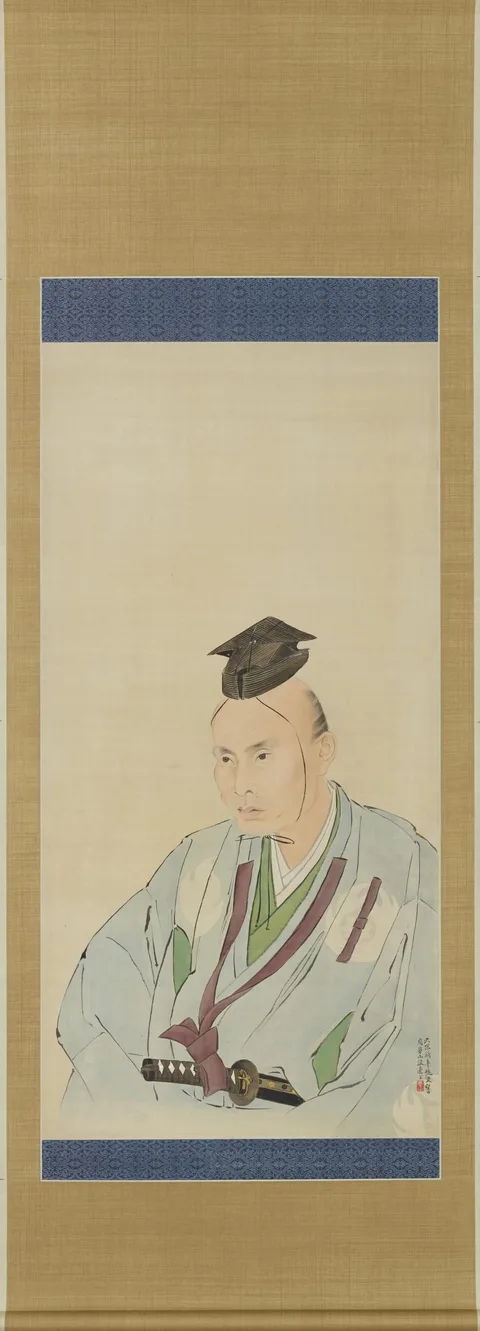
Watanabe Kazan
A painter of the late Edo period and a senior retainer (karo) of the Tahara domain in Mikawa Province (now Tahara, Aichi Prefecture). He painted realistic portraits that adopted the shading of Western painting. "The Scholar Takami Senseki" is a National Treasure.
Watanabe Kazan was born in 1793 (Kansei 5) to a samurai family at the Tahara domain's upper residence at Miyakezaka in Edo. His family was poor, and to help the household finances he learned painting, studying under Tani Buncho. While supporting himself with work such as painting lanterns, he also applied himself to scholarship. Later, as a senior retainer of the domain, he worked on restoring the domain's finances and preparing for famine.
Kazan also took an interest in rangaku (Western learning through the Dutch language), and learned how to express shading and volume from Western copperplate prints and the like. Combining this with the brushwork of traditional portraiture, he painted portraits that capture even the bone structure and expression of the sitter. "The Scholar Takami Senseki" (1837, Tenpo 8; Tokyo National Museum) depicts Takami Senseki, a senior retainer of the Koga domain and also a scholar of Dutch learning, with a calm, dignified face rendered in fine shading. He is also known for "Issodai-hyakutai" (Tahara City Museum), which captures people of the Edo townscape with a swift brush.
In 1839 (Tenpo 10) he was arrested on charges of criticizing the shogunate's foreign policy (the Bansha no Goku) and ordered into confinement at his home domain of Tahara. Two years later, in 1841 (Tenpo 12), he took his own life in Tahara. In Tahara there are the Kazan Shrine, which honors him, and the Tahara City Museum. His painting was carried on by pupils such as Tsubaki Chinzan.