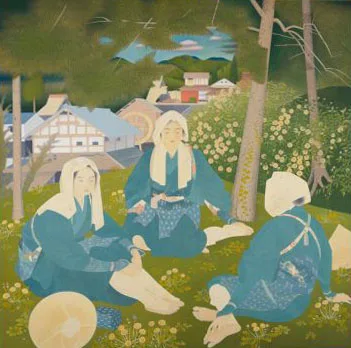
Tsuchida Bakusen
A Nihonga painter from Sado, Niigata Prefecture. He studied in Kyoto under Takeuchi Seiho and founded the Kokuga Sosaku Kyokai, aiming for a new Nihonga that also took in the forms of Western painting.
Tsuchida Bakusen was born in 1887 (Meiji 20) in Niibo Village on Sado (now Sado). In his teens he went to Kyoto, becoming a pupil first of Suzuki Shonen and later of Takeuchi Seiho. He also studied at the Kyoto City Specialist School of Painting, and won awards repeatedly with works shown at the Bunten.
In 1918 (Taisho 7) he formed the Kokuga Sosaku Kyokai (Association for the Creation of National Painting) with young Kyoto Nihonga painters who doubted the Bunten's judging. His companions included Ono Chikkyo, Murakami Kagaku, Sakakibara Shiho, and Nonagase Banka. Learning from the handling of color and form by Western painters such as Gauguin and Cezanne, Bakusen sought new expression using the traditional materials of Nihonga. From 1921 (Taisho 10) he traveled in Europe for nearly two years and saw Western classical paintings firsthand.
"Oharame (Woman Peddlers from Ohara)" (1927, Showa 2) at the National Museum of Modern Art, Kyoto, depicts women from Ohara, in the northern outskirts of Kyoto, who came into the city to sell firewood and brushwood carried on their heads. He painted the three women large, in calm colors and firm forms, and worked them into a decorative picture together with the trees and mountains behind. After the Nihonga section of the Kokuga Sosaku Kyokai dissolved, he returned to the Teiten and served as a juror and a member of the Imperial Academy of Fine Arts. He died in Kyoto in 1936 (Showa 11). Other major works include "Yuna" (1918, Taisho 7; National Museum of Modern Art, Tokyo) and "Maiko in a Garden."