Tawaraya Sotatsu
A painter of Kyoto in the early Edo period. He ran the painting shop Tawaraya and, in collaborations with Hon'ami Koetsu and others, remade yamato-e with bold compositions. Known for the "Wind God and Thunder God" screens, he is regarded as the founder of the Rinpa school.
Tawaraya Sotatsu is a painter whose birth and death years are unclear. "Tawaraya" was his shop name, and he is thought to have run a painting shop in Kyoto that made and sold pictures for fans, shikishi cards, screens, and the like. He teamed up with Hon'ami Koetsu, who excelled in calligraphy, ceramics, and lacquer, painting underdrawings of cranes and plants in gold and silver on the papers on which Koetsu wrote waka poems.
Sotatsu eventually received commissions from the imperial court and from temples, and around 1630 (Kan'ei 7) had gained the rank of hokkyo, given to monks and painters. At Yogen-in in Kyoto, the white elephants and Chinese lions he painted on cedar doors survive. The technique called tarashikomi, in which another color or water is dripped onto dark color before it dries so that it bleeds, is also said to have been devised by Sotatsu. The "Wind God and Thunder God" screens (National Treasure) at Kenninji in Kyoto are known for a bold composition that places the two gods at the far ends of a gold ground and leaves the center wide open.
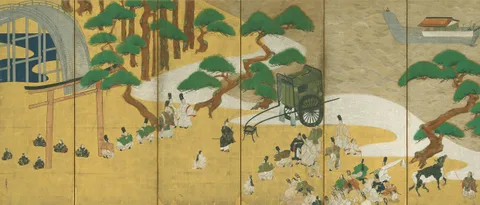
The Seikado Bunko Art Museum's "The Sekiya and Miotsukushi Chapters of The Tale of Genji" (National Treasure) depicts the "Sekiya" and "Miotsukushi" scenes of The Tale of Genji on the left and right screens. Records show that it was presented to Daigoji in Kyoto in 1631 (Kan'ei 8). With the ox carriage, pines, and waves arranged in large, simple forms, he turned the story picture into a decorative work that catches the viewer's eye. Sotatsu's style was later inherited by Ogata Korin.