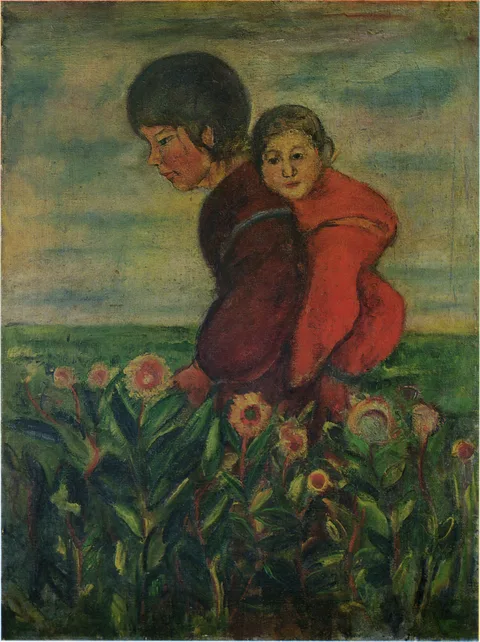
Sekine Shoji
A Western-style painter born in Shirakawa, Fukushima Prefecture. He drew attention at the Nika exhibition in the Taisho era but died at 20. Known for dreamlike works built on strong reds, his "Sorrow of Faith" is an Important Cultural Property.
Sekine Shoji was born in 1899 (Meiji 32) in Onuma Village, Nishishirakawa District, Fukushima Prefecture (now Shirakawa). In 1908 (Meiji 41) he followed his father, who had gone to Tokyo earlier, and moved to Fukagawa in Tokyo. One of his elementary-school classmates was Ito Shinsui, later a Nihonga painter. In 1914 (Taisho 3), through an introduction from Shinsui, he took a job at a printing company and began to paint while working.
In 1915 (Taisho 4), "Thinking of Death," painted at 16, was accepted to the 2nd Nika exhibition. At the 5th Nika exhibition in 1918 (Taisho 7), "Sorrow of Faith" (Ohara Museum of Art, Important Cultural Property) and other works won the Chogyu Prize, and he drew attention as a young talent. Strong reds close to vermilion and figures that suggest prayer and visions are the major features of Sekine's work.
But in June 1919 (Taisho 8) he died of tuberculosis, just twenty years old. He was active as a painter for only a few years. The Fukushima Prefectural Museum of Art in his home prefecture holds many of his works, including "Infant and His Sister," "A Prayer to God," and a self-portrait, and makes Taisho-era Western painting centered on Sekine one of the pillars of its collection.