Giovanni Segantini
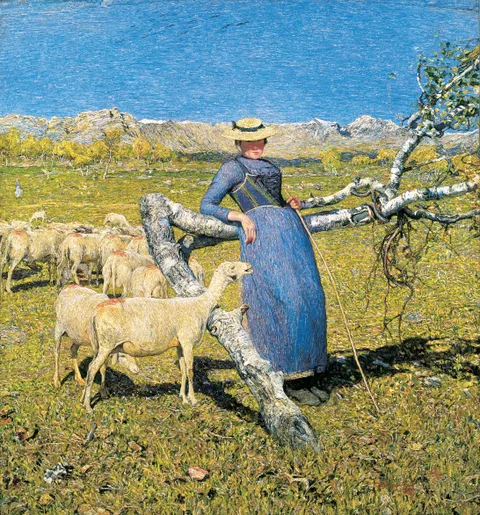
A painter who worked in the high Alps in the late 19th century. Setting fine strokes side by side without mixing colors, he painted clear mountain light and the lives of herdsmen. The Ohara Museum of Art holds his "High Noon in the Alps."
Giovanni Segantini was born in 1858 in Arco in northern Italy, then part of Austria. He lost his mother when very young and had a hard boyhood in Milan. After studying at the Brera Academy in Milan, he began painting the lives of shepherds and farmers in the countryside of northern Italy.
In 1886 he moved to the Alpine village of Savognin in eastern Switzerland and then to Maloja, higher up, where he went on painting the mountain landscape and its people. Segantini used the technique of divisionism, placing color in thin parallel strokes without mixing the paints. This keeps the colors from turning muddy and renders the strong sunlight and clear air of the heights brightly. "High Noon in the Alps" (1892) at the Ohara Museum of Art is also a painting of midday sun pouring over the high pastures in this technique. "The Evil Mothers" (Belvedere, Vienna), on the symbolic theme of mother and child, is another major work. He also liked to paint flocks of sheep and cattle and the people who worked with them.
In his last years he worked on the triptych "Life, Nature, Death," which links the Alpine landscape with the course of a human life. While staying high in the mountains to paint it, he fell ill in 1899 and died at 41. In St. Moritz, Switzerland, there is a museum that bears his name, and the triptych is now displayed there.