Claude Monet
A leading painter of French Impressionism. He pursued the shifting of light and air in series on a single subject, and in his later years kept painting the water lilies of his garden at Giverny. In Japan his works can be seen at places such as the National Museum of Western Art.
Claude Monet was born in Paris in 1840 and spent his boyhood in the Normandy port town of Le Havre. The landscape painter Boudin taught him to paint outdoors, and in Paris he came to know Renoir and others. The name "Impressionism" arose from the title of "Impression, Sunrise," which he showed in an exhibition held with his colleagues in 1874. When the Franco-Prussian War began in 1870 he fled to London, where he saw landscapes by Turner and others.
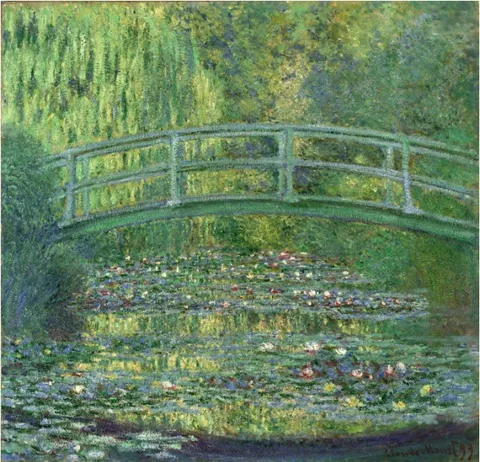
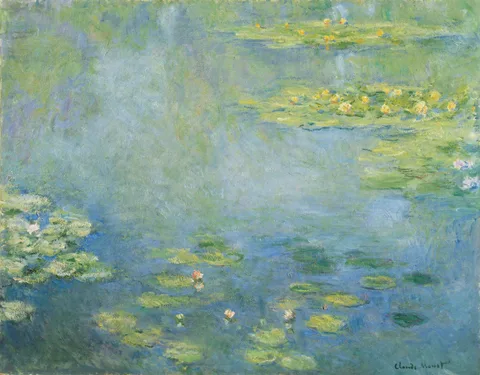
Rather than rendering forms in fine detail, Monet laid down short strokes of paint to convey the sparkle of light. He is known for series in which he painted the same motif many times at different hours and in different weather, such as haystacks, Rouen Cathedral, and rows of poplars. From 1883 he lived at Giverny, west of Paris, where he built a pond and grew water lilies. His paintings of this pond number more than 200 up to his death in 1926.
Monet collected ukiyo-e and hung them in his house at Giverny. He built a Japanese-style arched bridge over his water lily pond, and also left "La Japonaise," a painting of his wife in a kimono. "Water Lilies" (1916) at the National Museum of Western Art is known as a work that the businessman Matsukata Kojiro bought directly from the painter when he visited his studio. The Ohara Museum of Art and the Pola Museum of Art also hold paintings of water lilies.