Jean-François Millet
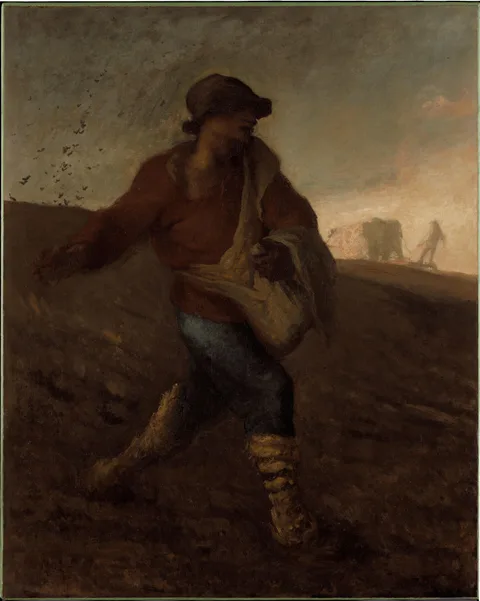
A 19th-century French painter. He lived in the village of Barbizon outside Paris and painted farmers at work in the fields in plain, weighty compositions. The Yamanashi Prefectural Museum of Art holds his "The Sower."
Jean-Francois Millet was born in 1814 in the seaside village of Gruchy in Normandy, in northwest France, the eldest son of a farming family. After studying painting in the port town of Cherbourg, he received a scholarship and went to Paris. At first he made a living with portraits and mythological paintings. In Paris he studied in the studio of the history painter Delaroche. He had grown up helping with the work in his family's fields from childhood.
In 1849 he moved to the village of Barbizon, near the Forest of Fontainebleau outside Paris. Painters who sketched nature, including Rousseau, had gathered there. Millet chose the labor of the village farmers as his subject and painted works such as "The Gleaners" and "The Angelus." His approach valued the movement and mass of bodies planting their feet in the earth over faces and details. He died in Barbizon in 1875. "The Gleaners" and "The Angelus" are now in the Musee d'Orsay in Paris.
"The Sower" (1850) at the Yamanashi Prefectural Museum of Art powerfully fills the canvas with a farmer striding across a field at dusk, scattering seed. The museum acquired it before its opening in 1978 and became known as a museum collecting works by Millet and the Barbizon school. Van Gogh was also strongly drawn to this subject and copied it many times.