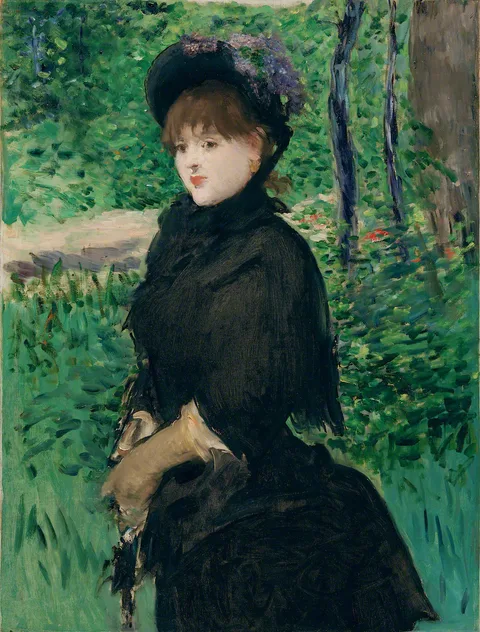
Édouard Manet
A 19th-century Parisian painter. He boldly painted the people of the contemporary city in flat compositions of strong light and dark, and was admired by the young Impressionists. The Tokyo Fuji Art Museum holds his "The Promenade (Madame Gamby)."
Edouard Manet was born in 1832 into a wealthy Paris family. He aimed to be a naval officer but failed the exam and studied for about six years in the studio of the painter Thomas Couture. At the Louvre he eagerly studied the masterpieces of the past, such as those of the Spaniards Velazquez and Goya.
"Luncheon on the Grass" (1863) and "Olympia," shown at the Salon (the official exhibition) in 1865, drew fierce condemnation for painting contemporary nudes without the disguise of myth. Even so, Manet kept insisting on being accepted at the official exhibitions. His strong light and dark, without middle tones, and his flatly painted areas of color stimulated the young Monet, Renoir, and others. A major late work is "A Bar at the Folies-Bergere." Manet himself never took part in an Impressionist exhibition, but in his last years he learned from Monet and others and adopted brighter tones. He liked to paint scenes of the contemporary city, such as Paris streets, theaters, and cafes.
Manet was interested in Japanese art as well. In his portrait of his friend the writer Zola (1868), he included in the background a ukiyo-e print of a sumo wrestler and a Japanese screen. "The Promenade (Madame Gamby)" (around 1880-81) at the Tokyo Fuji Art Museum is a full-length figure of a woman walking in a garden, painted in his last years when he was ill. He died in Paris in 1883.