Kusumi Morikage
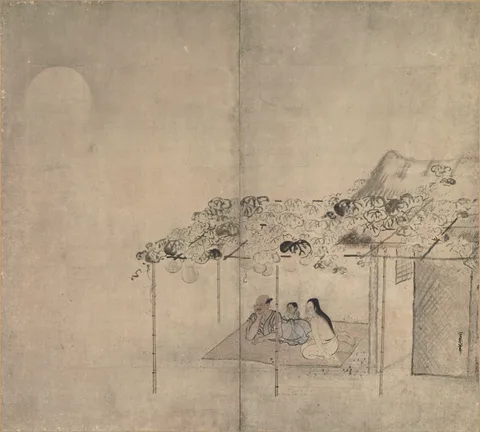
A painter of the early Edo period. He studied under Kano Tanyu and was counted one of the Four Heavenly Kings of his school, and later painted village life with warmth. "Cooling Off" at the Tokyo National Museum is a National Treasure.
Little is known about Kusumi Morikage, whose birth and death years and detailed biography are unclear. He studied under Kano Tanyu in Edo and was counted among the "Four Heavenly Kings," the four outstanding pupils of Tanyu's school. In 1642 (Kan'ei 19) he took part with Tanyu and others in producing the wall paintings of Shojuraigoji in Otsu, Omi (now Shiga Prefecture). The work with a firmly known date among his surviving works is said to be the "Sixteen Arhats" from this project. He is said to have married a niece of Tanyu and been related to his teacher by marriage.
Morikage later left the Kano school. Some say he was expelled, but nothing is certain. For a time in his late years he took refuge in Kanazawa in Kaga (now Ishikawa Prefecture) and left works in the Hokuriku region. He is said to have moved to Kyoto in his last years. His daughter Kiyohara Yukinobu is also known as a painter.
"Cooling Off" (Tokyo National Museum) shows a summer evening in which a husband, wife, and child sit on a mat under a trellis of evening-glory gourds to cool off. Rather than the Chinese legends and bird-and-flower subjects at which the Kano school excelled, it makes a family of nameless farmers its subject. The moon and the gourd flowers, painted in pale ink and light colors, convey a quiet, relaxed mood. "Farming through the Four Seasons" screens, depicting farm work through the year, were also a theme Morikage favored. A warm gaze toward the lives of ordinary people is the hallmark of his painting.