Kano Mitsunobu
A painter of the Kano school in the Momoyama period. The eldest son of Kano Eitoku, he led the Kano school after his father's death and took on work for the Toyotomi and Tokugawa. In contrast to his father's powerful manner, he is known for a delicate, gentle style.
Kano Mitsunobu was born in Kyoto, the eldest son of Kano Eitoku, who had served Oda Nobunaga and Toyotomi Hideyoshi. When his father died suddenly in 1590, he became the center of the Kano school and is said to have led the production of wall and screen paintings for Hideyoshi's castles and temples. It was an age when great buildings for the rulers of the realm rose one after another, and the Kano school worked as a studio with many pupils, dividing up the commissions.
Eitoku's style was grand, with huge trees with thick trunks filling the picture. Mitsunobu, by contrast, is said to have preferred delicate compositions that drew on the yamato-e tradition, with fine lines and subdued colors. After the Battle of Sekigahara he also accepted work from the Tokugawa, laying the groundwork for the Kano school to keep serving the shogunate in the next era.
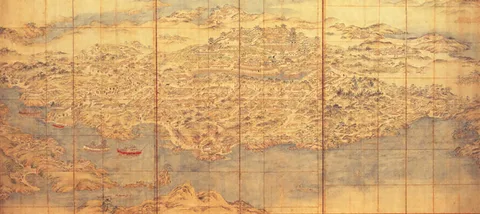
He is said to have died at Kuwana in 1608, on the way back to Kyoto after finishing work in Edo. The folding screen "View of Nagoya Castle in Hizen and Its Castle Town" is attributed to Mitsunobu, though it has also been suggested that it may be a preparatory sketch or a copy. Not many works are firmly his, and attributions are treated with caution even among scholars.