Hirasawa Byozan
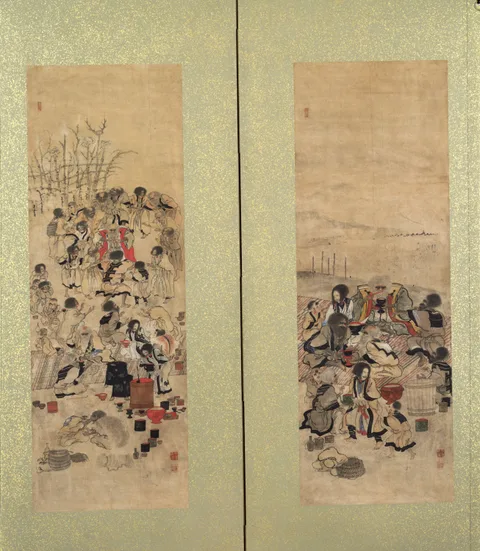
A painter based in Hakodate from the end of the Edo period into the early Meiji era, who painted many scenes of Ainu life and ritual. Regarded as one of the leading Ainu-e artists, his works survive in large numbers in Japan and in museums in Europe and America.
Hirasawa Byozan was born in 1822 in Osako, Hienuki District, Mutsu Province (now Hanamaki, Iwate Prefecture). After losing his father when young, he is said to have moved with his younger brother to Hakodate in the 1840s and to have made a living painting ship votive plaques and the like. There is no record of formal training, and he is thought to have been largely self-taught.
He eventually won the favor of a Hakodate merchant and is said to have lived among the Ainu at the Hidaka and Tokachi fishing grounds the merchant held under contract, painting their customs. Byozan's Ainu pictures, with scenes such as the bear-sending ritual, drinking feasts, fishing, and interiors of houses, became popular and drew many commissions. Many works reuse the same compositions, and he is thought to have been a town painter who varied his pictures to fit orders. It has also been pointed out that he used a synthetic blue pigment made in 19th-century Europe.
After Hakodate opened as a port, foreigners also sought Byozan's pictures as souvenirs, and many of his late works went abroad. He died in Hakodate in 1876. Works well known in Japan include the Ainu Banquet folding screen at the Tokyo National Museum and a picture of the bear-sending ritual at the Hakodate City Central Library.