Hasegawa Tohaku
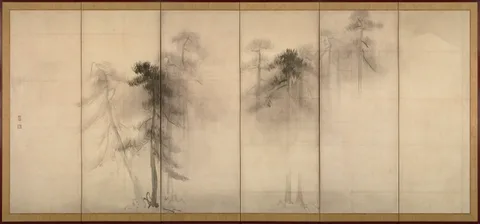
A painter who came from Nanao in Noto to Kyoto and was active in the Azuchi-Momoyama period. He painted widely, from gold-and-blue wall paintings to ink paintings. "Pine Forest" at the Tokyo National Museum is a National Treasure.
Hasegawa Tohaku was born in 1539 (Tenbun 8) in Nanao, Noto Province (now Nanao, Ishikawa Prefecture). In his youth he used the name Nobuharu and painted Buddhist paintings and portraits for Nichiren temples in the region. The leading theory is that he went to Kyoto around 1571 (Genki 2), in his thirties. His Buddhist paintings from the Noto period survive at temples in Ishikawa and Toyama Prefectures and elsewhere.
In Kyoto he based himself at the Nichiren temple Honpoji and also mixed with tea masters of Sakai such as Sen no Rikyu, whose portrait he painted. Around 1593 (Bunroku 2) he led his studio in painting the wall paintings of Shounji, built by Toyotomi Hideyoshi. They are now preserved at Chishakuin in Kyoto, where Tohaku's "Maple Tree" and "Cherry Tree," attributed to his son Kyuzo, among others, are National Treasures. Their grand depictions of large trees on gold grounds won him standing alongside the Kano school, the dominant school of the day. Tohaku called himself "fifth generation after Sesshu," presenting himself as a painter in the line of the great ink master Sesshu. The "Maple Tree" is striking for its thick trunk stretching across the whole picture and its many-colored leaves.
"Pine Forest" (Tokyo National Museum), by contrast, depicts a pine grove floating in mist in ink alone. The unpainted space gives a feeling of damp air and depth. In 1610 (Keicho 15) he was invited by Tokugawa Ieyasu and set out for Edo, but died soon after arriving.