Paul Gauguin
A French painter. He turned from stockbroker to artist and, in Brittany and Tahiti, painted pictures of flat areas of color with clear outlines. In Japan his works can be seen at the National Museum of Western Art and the Ohara Museum of Art.
Paul Gauguin was born in Paris in 1848 and spent his early childhood in Lima, the capital of Peru. After a time as a sailor, he worked in Paris as a stockbroker and began painting as a Sunday painter. Advised by Pissarro, he also showed at Impressionist exhibitions, and after the economic downturn of the 1880s he devoted himself to painting.
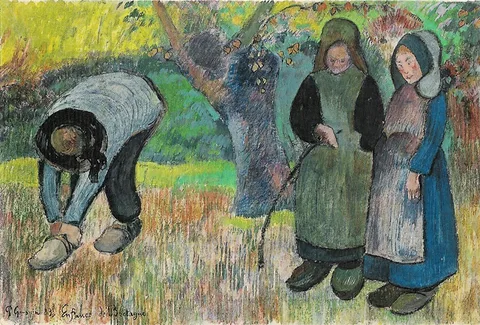
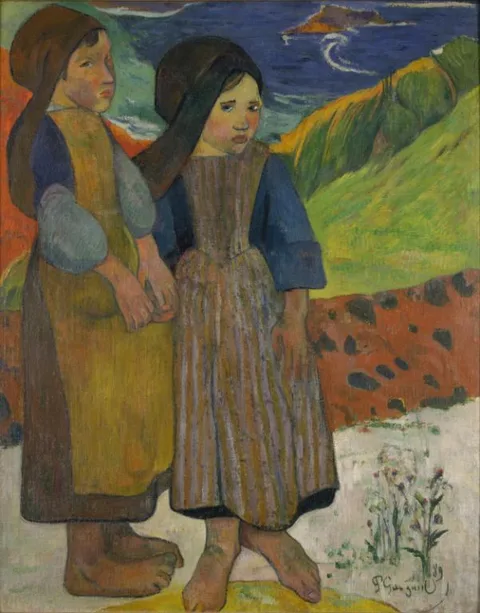
From 1886 he went regularly to the Brittany village of Pont-Aven, where with young painters he developed a style of vivid areas of color divided by heavy outlines. "Two Breton Girls by the Sea" (1889) at the National Museum of Western Art gathers girls in regional dress into simple, powerful forms. In 1888 he lived with van Gogh in Arles, but this lasted only about two months.
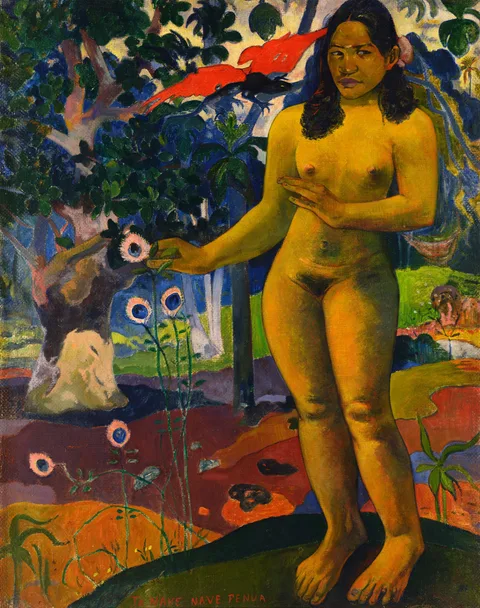
In 1891 he went to Tahiti in the South Pacific and took the islanders and their myths as subjects. "Te Nave Nave Fenua (The Delightful Land)" (1892) at the Ohara Museum of Art was painted during his first stay in Tahiti and was bought in Europe by the Western-style painter Kojima Torajiro. In his last years he moved to the Marquesas Islands and died in 1903 at Atuona on Hiva Oa. From 1897 to 1898 he completed the large work "Where Do We Come From? What Are We? Where Are We Going?" (Museum of Fine Arts, Boston), which shows the whole of human life in one picture.