Fujishima Takeji
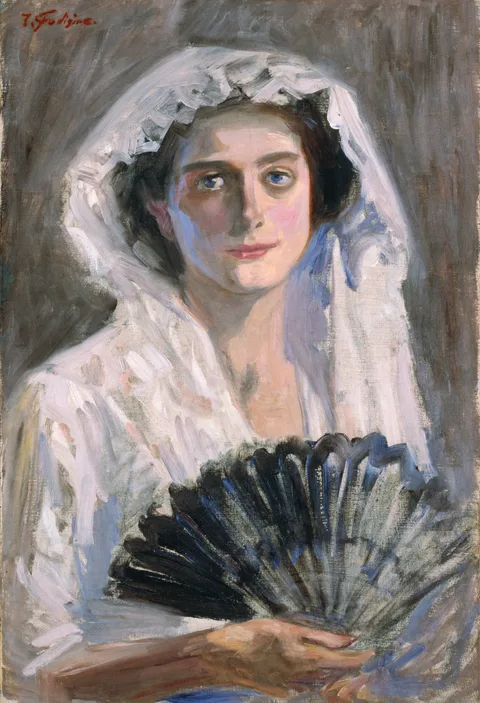
A Western-style painter from Kagoshima. He taught for many years at the Tokyo School of Fine Arts and combined the Western techniques he learned abroad with Japanese decorative sensibility. "The Black Fan," painted in Rome, is an Important Cultural Property.
Fujishima Takeji was born in 1867 (Keio 3) in Kagoshima into a Satsuma domain samurai family. He went to Tokyo, first studied under the Nihonga painter Kawabata Gyokusho, and then turned to Western painting. In 1896 (Meiji 29), on the recommendation of fellow Kagoshima native Kuroda Seiki, he became an assistant professor in the newly created Western painting department of the Tokyo School of Fine Arts. In "Traces of the Tenpyo Era" (1902, Meiji 35) he painted a woman in Nara-period dress with an ancient harp-like instrument. In the 1900s (Meiji 30s) he also did covers and illustrations for Myojo, the literary magazine of Yosano Tekkan and Akiko.
In 1905 (Meiji 38) he went to Europe as a Ministry of Education scholarship student, studying under Fernand Cormon in Paris and Carolus-Duran in Rome. "The Black Fan" (1908-09, Meiji 41-42; Artizon Museum) was painted during his stay in Rome. It shows a woman in a white veil holding a black fan, in swift, bold brushwork.
After returning, he trained many Western-style painters as a professor at the Tokyo School of Fine Arts. In his later years he came to paint landscapes such as sunrises, seas, and mountains in simplified, powerful forms. He received the first Order of Culture in 1937 (Showa 12) and died in 1943 (Showa 18). Major late works include "Sunrise over the Eastern Sea" and "Plowing to the Heavens." His pupils include Koiso Ryohei and Inokuma Genichiro.