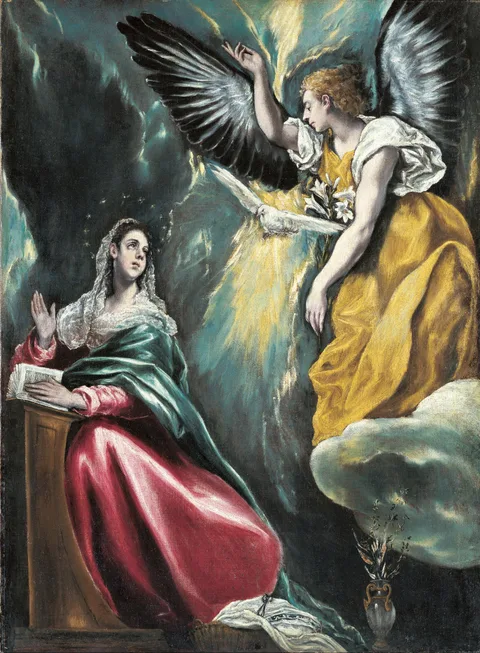
El Greco
A painter born on the Greek island of Crete who worked in Toledo, Spain. He painted religious subjects with elongated figures and flickering light and color. The Ohara Museum of Art holds his "The Annunciation."
El Greco, whose real name was Domenikos Theotokopoulos, was born in 1541 on Crete, then a Venetian possession. "El Greco" is a nickname meaning "the Greek" in Spanish. He first trained as a painter of icons in the Eastern Orthodox tradition.
In his twenties he went to Venice and studied the colorful paintings of the Venetian school, including Titian. After passing through Rome he moved around 1577 to Toledo, Spain, and worked there until his death in 1614. His best-known work is "The Burial of the Count of Orgaz" in the church of Santo Tome in Toledo. The long, distorted bodies, robes that waver like flames, and strong contrasts of light and dark were devices for depicting earth and heaven in a single picture. His "View of Toledo" (Metropolitan Museum of Art) is also well known. During his stay in Rome he also learned much from Michelangelo's treatment of the human body.
"The Annunciation" (around 1590-1603) at the Ohara Museum of Art shows the angel Gabriel telling the Virgin Mary that she will bear the Son of God. The Western-style painter Kojima Torajiro bought it in Paris in 1922. It is one of the few works by El Greco in Japanese museums, and the oldest of the Western paintings in the Ohara Museum of Art.